
Slat wall panels
Slat Wall Panels in Southampton and Hampshire
Slat wall panels give a wall a regular pattern of vertical lines. The spacing, cut edges and details around sockets make as much difference as the panel itself.
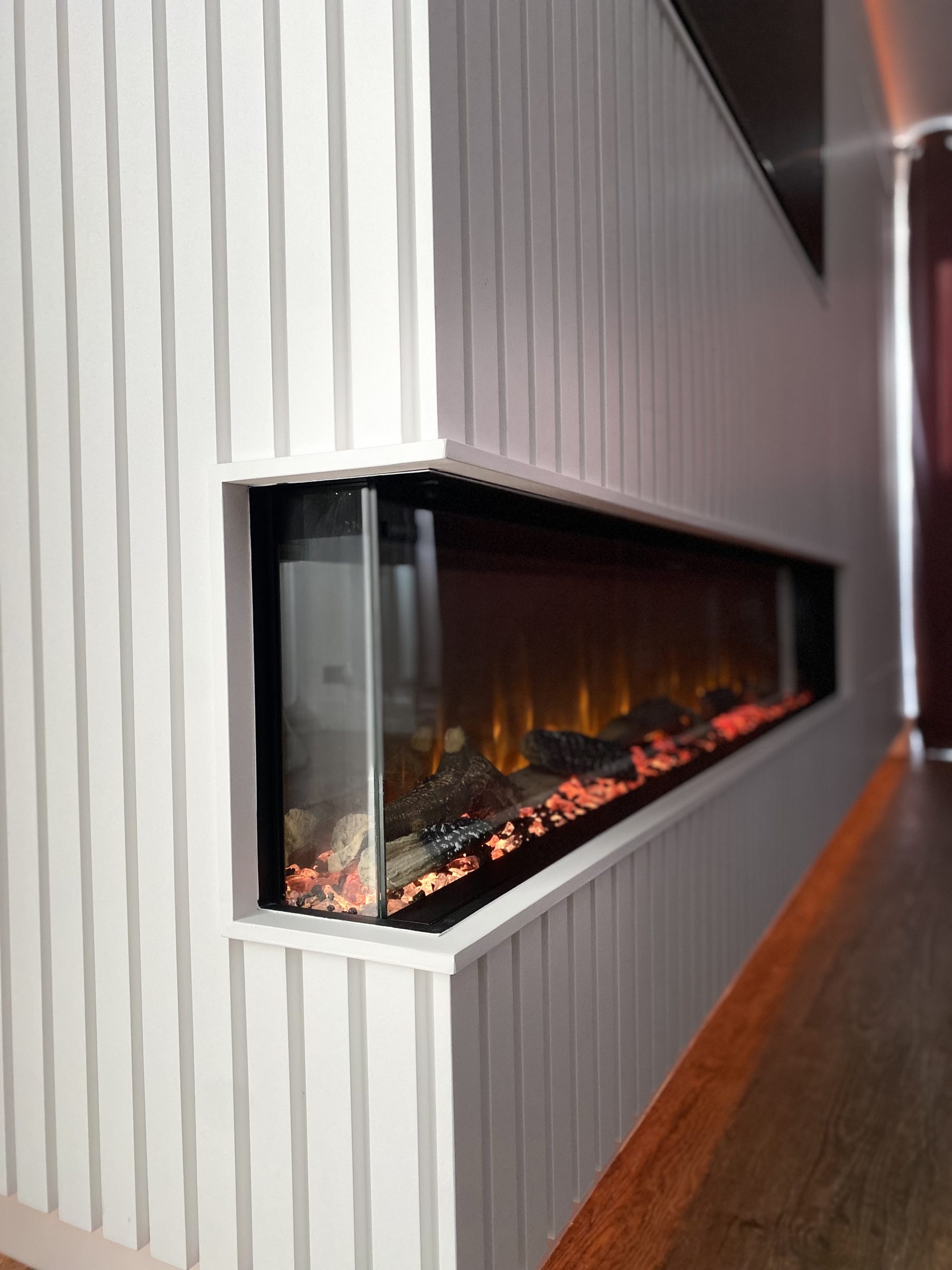
Slatted wall panels use separate strips or a repeating strip pattern. Fluted wall panels have rounded or grooved profiles across a continuous face. Both create shadow lines, but they are not the same material or fixing system. Choose the profile first, then check how it finishes at corners, window reveals and the edge of a feature wall.
What to consider
- Layout set against corners and openings
- Cut edges and end trims planned before fitting
- Sockets and cables kept accessible
- Fire clearances checked against the appliance instructions
Slatted and fluted wall panels
Slatted finishes already form part of the media-wall work shown on this site. A wooden slat wall can stand alone or sit within a larger fitted wall. Fluted panelling needs the same attention to the actual product: its backing, thickness and edge detail determine how it should be cut and fitted.
Setting out the full wall
Measure the width at more than one height. Floors, ceilings and corners are not always straight, so a full-width run should be set out before the first panel is fixed. Decide whether the pattern is centred on the wall, the television or another main feature. These can be different positions.
A small strip at one end can make an otherwise regular layout look unfinished. Check the panel repeat and the finished width together, allowing for any trims. Around sockets, keep the faceplate supported and accessible rather than burying it between slats. Electrical alterations should be arranged with an electrician before the covering closes the wall.
Acoustic slat wall panels
Some acoustic slat panels have an absorbent backing and a tested installation method. A decorative slatted face alone is not evidence of sound insulation. Acoustic performance depends on the complete assembly, including the backing, any air gap and the surface behind it. Read the product test information for the proposed fitting method.
Reducing echo within a room is different from stopping sound travelling to the next room. If noise through a shared wall is the problem, start by identifying the route it takes. A thin decorative covering should not be treated as a substitute for a designed sound-insulation build-up. Avoid comparing products by appearance alone.
Slat walls around a fireplace
A slat wall fireplace layout needs the appliance details before the panelling is designed. Timber, veneers, felt and adhesives may have temperature or fire limitations. Keep the manufacturer’s required clearances and choose materials suitable for the position. An electric fire and a solid-fuel stove do not have interchangeable installation requirements.
Plan the recess, ventilation openings and any removable access at the same time as the visible pattern. Cutting slats neatly around a fire is only part of the job. The structure must also support the finish and leave the appliance serviceable. The media-wall service covers the wider layout where a television, fire and storage are being planned together.
See also: made-to-measure media walls.
Cutting, painting and cleaning
Can slat walls be cut? Most panel systems can be trimmed, but the tool and blade depend on the face material and backing. Support the panel during cutting and check which edge will remain visible. A veneer cut needs different treatment from a painted MDF edge. Fluted wall panels also need the pattern aligned across joins.
Painting is possible only where the product and finish allow it. A factory-finished veneer may need a different preparation from bare MDF, and painting an acoustic backing may affect its performance. Test an offcut first and follow the supplier’s instructions. For routine care, use the recommended cleaning method rather than soaking the joints or backing.
Planning the next step
Use the enquiry form on this page to describe the space and the work you are considering. Include the main dimensions, the finish you prefer and anything that needs to stay accessible. A photograph showing the whole wall is more useful than a close-up alone. You can also call VIP Walls to talk through the room before choosing materials.
See also: Related joinery and fitting.
Slat Wall Panels across Hampshire
The dimensions, existing fittings and access need checking before the layout and fixing method are agreed.
Where we work
Based in Hampshire since 2007 and working across the county.
Houses we work in
- houses
- flats
- rooms with awkward corners
Ask about slat wall panels
Slat wall panels give a wall a regular pattern of vertical lines. The spacing, cut edges and details around sockets make as much difference as the panel itself.
Slat Wall Panels questions
- Can I paint slat wall panels?
- Check the face material and existing finish first. Paintable MDF and finished veneer need different preparation. Do not coat an acoustic backing unless the product instructions allow it.
- Can slat walls be cut?
- Most systems can be cut to size with the correct tools. The exposed edge, backing and fixing method need planning before the panel is trimmed.
- Can you cut fluted wall panels?
- Usually yes, following the product instructions. Keep the profile aligned across joins and plan a trim or finished edge where a cut will be visible.
- Do acoustic slat panels soundproof a room?
- They may reduce echo when fitted as tested. That is not the same as preventing noise passing between rooms. Check the complete assembly and the problem you want to solve.
Read up before you commit
- Media wall ideas: planning a wall that hides the mess
TV height, fire clearances, cable routes, lighting and the details people forget.
- Media wall cost: what a media wall really costs to build
Real cost drivers behind a media wall, from a fitter who builds them every month.
- Panelling around radiators, sockets and skirting
What happens to radiators, sockets, skirting and windows when a wall is panelled, the questions we get asked on almost every job.
Other panelling and joinery
The short version
Slat wall panels give a wall a regular pattern of vertical lines. The spacing, cut edges and details around sockets make as much difference as the panel itself.
Ask about slat wall panels
Tell us what you have in mind, with a photo and rough measurements of the space.